
What Does It Mean To Feel Safe In Your Body? And Why Does It Matter So Much
There is a particular kind of exhaustion that has nothing to do with the amount of sleep you've had
It lives in the jaw that never quite unclenches. In the shoulders that creep toward the ears somewhere around mid-morning and stay there. In the mind that keeps running calculations long after the working day has ended — scanning, preparing, anticipating the next thing that might go wrong.
If this sounds familiar, it is worth asking a question that rarely gets asked:
When did you last feel genuinely safe?
Not just logically safe. Not "I know objectively that everything is fine." But safe in a deeper, quieter sense — where the body is still, the mind is unhurried, and there is no low-level hum of threat running beneath the surface of your day.
For many high-achievers, that feeling is so unfamiliar it is almost difficult to imagine.
And that matters more than most people realise.
Safety is not a feeling. It is a physiological state.
When most people hear the word "safety," they think of external circumstances. A secure home. Financial stability. The absence of immediate danger.
But in the context of your nervous system, safety means something more specific — and more interesting.
Your autonomic nervous system is constantly monitoring your internal and external environment, asking one fundamental question beneath conscious awareness:
Am I safe right now?
This process — called neuroception, a term developed by Dr. Stephen Porges through his work on Polyvagal Theory — happens automatically. You do not decide to do it. It simply runs, continuously, as a background process your body inherited from millions of years of evolution.
And the answer your nervous system arrives at shapes almost everything about how you think, feel, relate to others, and experience your own life.
This is what Porges calls the ventral vagal state. It is not a luxury. It is the physiological foundation from which genuine clarity, creativity, and connection become possible
What happens when safety is absent
Here is where it gets important for anyone who operates at a high level — professionally, creatively, or intellectually.
When the nervous system does not register safety, it shifts into protective mode. The sympathetic nervous system activates, flooding the body with stress hormones designed to mobilise action. Thinking narrows. Focus sharpens on threat. The body prepares to fight, flee, or — if the perceived threat feels overwhelming — to shut down entirely.
In acute situations, this is extraordinarily useful. It is the system working exactly as designed.
The problem arises when this state becomes the default.
When chronic stress, unprocessed pressure, relational strain, perfectionism, or years of pushing through have trained the nervous system to treat ordinary daily life as a low-grade threat — the system stays mobilised. Not dramatically. Not in a way that always looks like distress from the outside.
Often it looks like high performance.
It looks like someone who is always prepared, always productive, always slightly ahead of the next potential problem.
Until, eventually, it does not.
Why safety is the foundation of change — not the reward for it
This is perhaps the most important reframe in this entire post.
Many people approach personal development, therapy, or coaching with an implicit belief that safety — real ease, real calm, real presence — is something they will feel once they have done enough work. Once they have resolved enough, achieved enough, understood enough.
But the nervous system does not work that way.
Safety is not the outcome of the work. It is the condition that makes the work possible.
When the body is in a state of chronic activation or shutdown, the deeper layers of change — genuine behavioural shifts, lasting emotional patterns, new ways of relating to yourself and others — are extraordinarily difficult to access. Not because you are not trying hard enough. But because the physiological environment is not yet one in which that kind of change can take root.
This is why insight alone so rarely creates lasting transformation.
You can understand your patterns completely — map them, name them, trace them back to their origins — and still find yourself repeating them. Not because understanding is useless, but because understanding lives in the cortex, while the patterns themselves often live much deeper, in the body's learned predictions about what the world requires of you.
What nervous system safety actually feels like
It is worth naming this concretely, because for many people the concept remains abstract until they have experienced it.
Nervous system safety is not the same as happiness. It is not the absence of challenge or difficulty. It is not a permanent state that, once found, never wavers.
It tends to feel like:
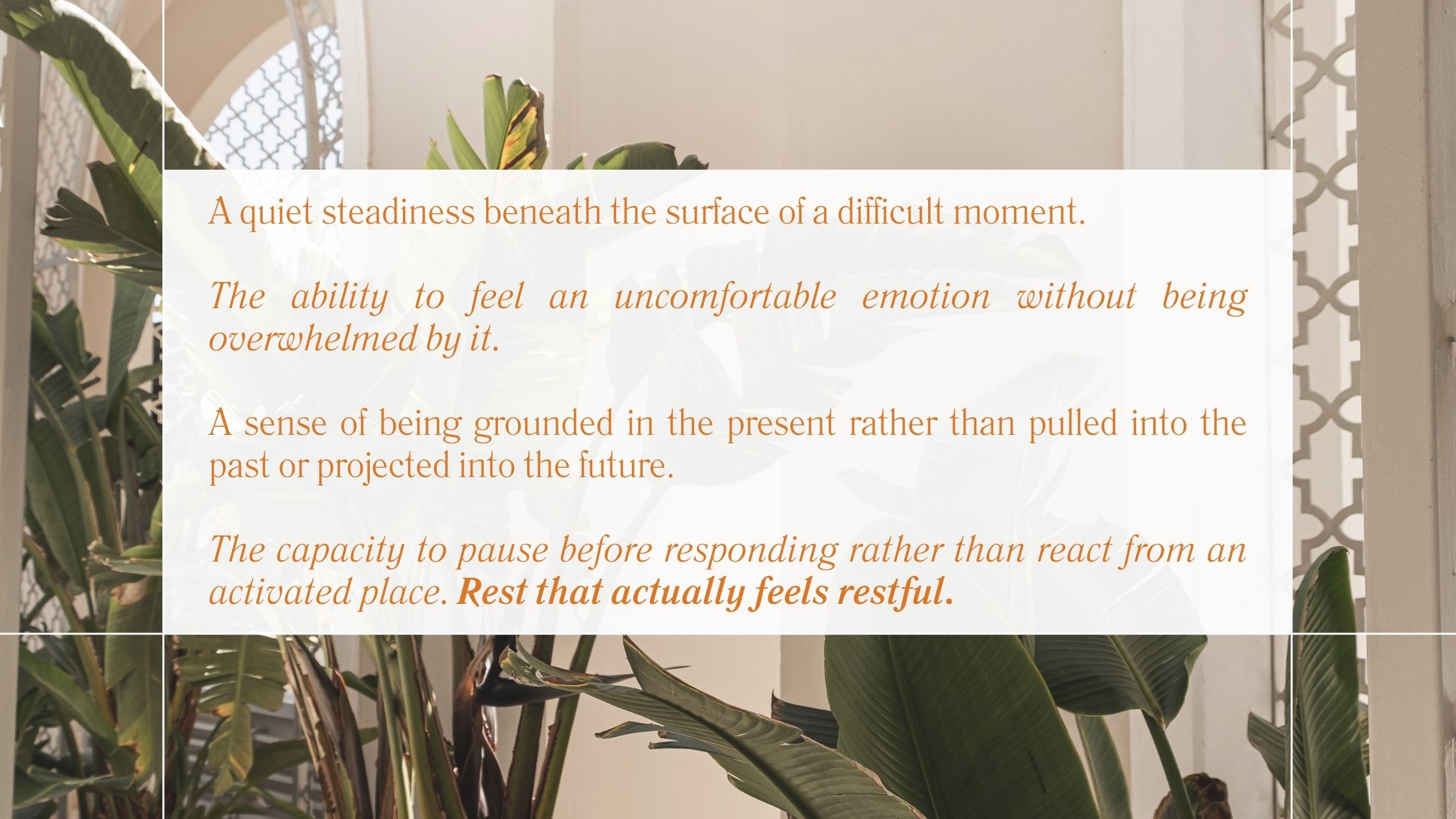
It is, in essence, the experience of your own system coming back into balance — not perfectly, not permanently, but genuinely.
And once someone begins to experience this, even briefly, something tends to shift in how they understand what is actually possible for them.
This is where change begins
If you have spent years working hard on yourself — reading, reflecting, developing self-awareness — and still find that something feels stuck, it may not be that you haven't understood enough.
It may be that the body hasn't yet learned that it is safe enough.
That is not a criticism. It is an invitation.
Because the nervous system is not fixed. It is flexible. It is capable of learning new patterns, updating old predictions, and gradually — with the right conditions and the right support — discovering that calm is not as far away as it might currently feel.
The question is not what is wrong with me.
The question is what has my system learned, and what might it learn next.
That shift — from self-judgment to curiosity — is often where everything begins to change.
If this resonates and you're curious about what nervous system-informed therapeutic work looks like in practice, you're welcome to explore working together. [Drop me a DM to Book a clarity call here.]